
Economic Front for Muslims in Palestine-Israel War | Practical Strategy for Moving Forward – Kamran

The Economic Front — A Practical Strategy for Muslim Empowerment
Every time a crisis strikes the Muslim world, a familiar pattern follows.
Outrage. Protests. Social media campaigns. Boycott lists. Emotional declarations. And then — gradually, quietly — life returns to its previous rhythm. The urgency fades. The posts stop. The products come back to the shopping cart.
And nothing structurally changes.
I say this not to diminish the sincerity of those who grieve for Palestine — the grief is real, the injustice is undeniable, and the solidarity of the Ummah is one of the most beautiful expressions of our faith. But grief and solidarity, without strategy, do not change power equations. History has been consistent on this point.
What changes power equations is economic power. And the Muslim world — with its 1.8 billion people, its vast resources, its entrepreneurial energy, and its untapped market potential — has more of that power than it has ever chosen to deploy.
This blog is not about outrage. It is about strategy. Specifically — a four-phase roadmap for building a sustainable Muslim economic ecosystem that weakens those who oppress us and strengthens those who stand with us.
Why the Economic Front?
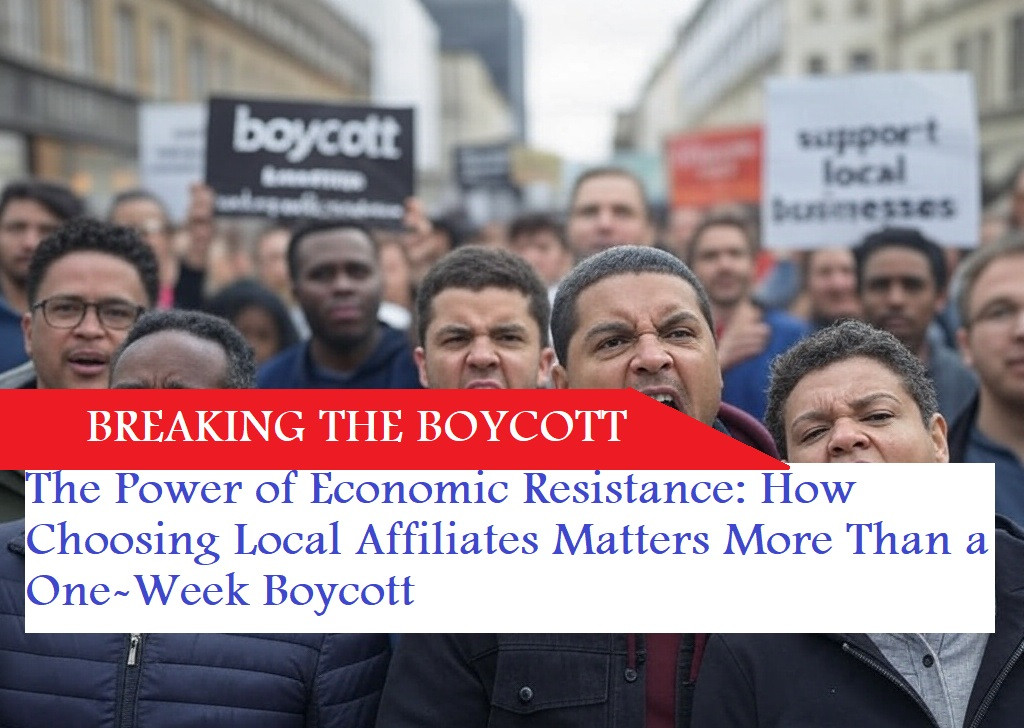 A boycott by itself is a statement. It is important — it communicates refusal, it applies pressure, and it is the minimum expectation of every Muslim consumer who understands what their money funds.
But a boycott alone does not build anything. And we do not only need to weaken — we need to build.
The economic front is the most practical, most sustainable, and most scalable arena available to ordinary Muslims. You do not need political access. You do not need military capacity. You need entrepreneurial will, strategic coordination, and the discipline to build over the long term.
The question is not whether Muslims have the capacity to build a powerful economic ecosystem. We do. The question is whether we have the strategy and the discipline to do it.
Here is the strategy.
Watch the Full Discussion
Before walking through the framework in detail — watch this video. It is the full strategic discussion from which this blog is drawn.
[🎥 EMBED VIDEO: https://youtu.be/37gMX5NuSTI]
The 4-Phase Framework
Phase 1 — Tafakkur | The Think Tank
Timestamp: 02:54
Every revolution begins with thought. Before execution, before organisation, before any practical action — there must be a cohesive, serious, and sustained intellectual effort.
Tafakkur means deep reflection. And what the Muslim Ummah needs urgently is a structured think tank of Muslim thought leaders — economists, entrepreneurs, strategists, scholars, technologists — who can move beyond reactive commentary and build a coherent, long-term vision for Muslim economic empowerment.
This think tank must be:
- Cohesive — not fragmented by sectarianism, nationalism, or ego
- Practical — focused on actionable strategy, not theoretical debate
- Sustained — committed to the long term, not just the current news cycle
The output of Tafakkur is not a report. It is a shared vision — one that the next phase can translate into reality.
Phase 2 — Paish Khaima | The Base Camp
Timestamp: 03:23
A base camp is where the climb actually begins. Phase 2 is about translating the vision and ideas generated in Phase 1 into practical, fundable, executable projects.
This means:
- Identifying the specific sectors where Muslim businesses can most effectively compete and displace boycotted brands
- Building the infrastructure — investment networks, incubators, accelerators, supply chains — that new Muslim businesses need to launch and survive
- Creating the institutional structures that can coordinate effort across geographies — because the Muslim economic ecosystem cannot be built country by country in isolation
Paish Khaima is where the thinking becomes doing. It is unglamorous, detailed, and essential.
Phase 3 — Barpa | Execution
Timestamp: 05:02
This is the phase most people want to jump to — and the phase that fails most often when the previous two have been skipped.
Barpa — execution — operates through what I call the SOCIETY(R) Model. This is a framework for taking a Muslim business or brand from its current state to a position of genuine scale and integration within a larger ecosystem.
The SOCIETY(R) Model moves through four stages:
Standardisation — Before any business can scale, it must be standardised. Processes, quality, customer experience, product consistency — these must be defined and documented. A business that cannot run without its founder is not a business; it is a job. Standardisation is what transforms a good idea into a replicable system.
Optimisation — Once standardised, every element of the business must be examined for efficiency. Where is time being wasted? Where is money being lost? Where are customers being underserved? Optimisation is the discipline of making the machine run better before you make it run faster.
Scaling — Only after a business is standardised and optimised is it ready to scale. Scaling a broken system only amplifies the breakage. But scaling a well-built, efficient system — through expansion, franchise, licensing, or investment — is how individual businesses become forces in the market.
Integration — This is the phase that makes the SOCIETY(R) Model distinct from ordinary business growth frameworks. Individual Muslim businesses, no matter how successful, cannot alone shift the economic equation. Integration means connecting Muslim businesses into a coherent ecosystem — shared supply chains, cross-referral networks, collective purchasing power, unified brand standards. This is how you build not just businesses but an economy.
The goal of Phase 3 is not to produce successful individual businesses. It is to produce a functioning, interdependent Muslim economic ecosystem — one that is self-reinforcing, resilient, and capable of sustaining the pressure of competition from established global players.
Phase 4 — Inqilaab | Revolution
Timestamp: 08:04
Phase 4 is not something you plan. It is something you earn.
Inqilaab — revolution — is the organic result of the first three phases done well. When the thinking is serious, the infrastructure is built, and the execution is disciplined and sustained — the cumulative effect becomes transformative. Markets shift. Consumer behaviour changes permanently. The economic power of the Muslim world becomes visible, tangible, and respected.
This is not a romantic aspiration. It is a logical outcome. Economic ecosystems that are built with intention, sustained with discipline, and integrated with strategy do not stay small. They grow. They compound. They eventually reach a scale where they cannot be ignored.
The question is not whether this is possible. History has shown us — repeatedly — that Muslim civilisations have been among the greatest economic and intellectual forces the world has ever seen. The question is whether this generation is willing to do the patient, unglamorous, sustained work that Phase 1, 2, and 3 require.
A Direct Word to Muslim Entrepreneurs
If you are a Muslim entrepreneur, business owner, or professional reading this — this is your call.
Not to protest. Not to post. Not to sign a petition.
To build.
Build your business with the intention that it is part of something larger than your own income. Build it with standards worthy of the Ummah. Build it with the discipline to scale. And build it with the willingness to connect — to other Muslim businesses, to Muslim consumers, to Muslim investors — so that what you build becomes a brick in something that outlasts you.
The economic front is open. The strategy exists. The resources are in the Ummah.
What is needed now is the will to act — and the discipline to sustain that action long after the news cycle has moved on.
This is how we serve Palestine. Not only with our grief — but with our growth.
— Kamran Zahid, CEO, Purposelee

Responses